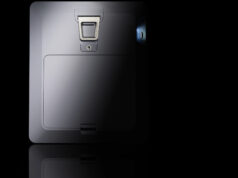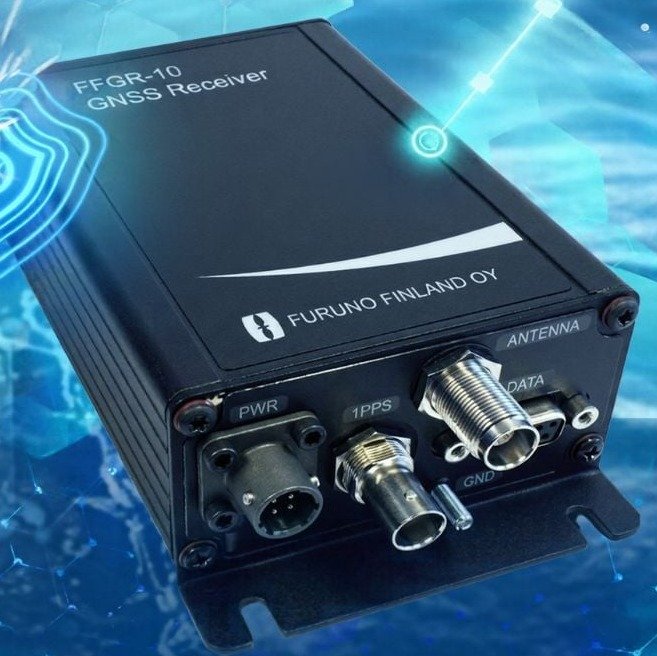
Furuno’s new FFGR-10 is a multi-band GNSS receiver built to keep giving a position when someone jams or fakes satellite signals. Furuno Finland announced it on 23 September 2026, after a showing at SMM Hamburg and a test run at Jammertest 2026 in Norway.
What the Furuno FFGR-10 does
Furuno says the FFGR-10 receives GPS, Galileo, GLONASS, BeiDou and QZSS signals on L1, L2 and L5 at the same time. Because it listens on three bands at once, Furuno says it keeps delivering a position when jamming hits any single band. It outputs at 10 Hz, with a stated 1.5 m horizontal accuracy.
At Jammertest, Furuno Finland ran the unit in a moving vehicle instead of fixed indoors, to mimic a vessel underway. Furuno’s reported results:
- Furuno says it resisted all but very strong spoofing and kept its fix under all but very strong jamming.
- It restored its position promptly after jamming stopped, with no reboot.
- It kept a position when jamming hit any one of the L1, L2 or L5 bands.
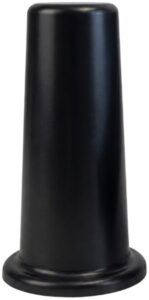
Furuno pairs the receiver with the Tallysman AJ977XF anti-jamming antenna. According to Furuno, it gives typically 20 dB of wideband suppression for signals arriving from 0° to about 15° elevation, which targets interference from near ground-based transmitters. However, the brochure lists the antenna as an option, so check what a quote includes.
Furuno FFGR-10 specifications
- Constellations and bands: GPS, Galileo, GLONASS, BeiDou and QZSS; L1, L2 and L5
- Accuracy and update rate: 1.5 m horizontal; 10 Hz
- Interfaces: four RS-422 serial ports on a D9 connector, carrying NMEA 0183 v4.11 (GGA, VTG, ZDA, DTM, RMC). Two run at 4,800 bps and 1 Hz. The other two run at 38,400 bps, at 1 Hz or 10 Hz for GGA and RMC. There is also a 1PPS output.
- Power: 9-36 VDC. Furuno’s announcement says 2 W maximum, while the manual says 1 W.
- Size and weight: receiver 159 x 84 x 48 mm and 410 g; antenna 245 g
- Protection: receiver IP22, so it is not waterproof; antenna IP67 in the brochure and IP66 in the manual
- Standard: IEC 60945 marine standard
- In the box: receiver, 2 m power cable and 1 m data cable
Furuno FFGR-10 as a SOLAS backup
Furuno says the FFGR-10 can serve as a backup to wheelmarked SOLAS GNSS receivers. The announcement adds “subject to flag state requirements”, and the manual says class or flag approval applies. In other words, Furuno does not present it as a replacement for the type-approved main receiver. For a SOLAS installation, the manual also says the FFGR-10 antenna must sit 1-2 m from the main receiver antenna.
Furuno FFSP-100 alarm
The FFSP-100 monitoring device is the companion product. It warns when GNSS signals are jammed or spoofed, and its alarm unit has a relay output for a vessel alarm system or an external buzzer. When the alarm sounds, the crew can switch to the FFGR-10.
Our take on the Furuno FFGR-10
Our early view is that Furuno aims the FFGR-10 mainly at SOLAS ships as a backup, so most leisure owners will not need one yet. Even so, its design shows where position-source resilience is heading. The big question is if a StarLink dish could do an equal or better job – as StarLink can provide lat/long to receivers. But that does require a StarLink subscription of course. Big transports or military vessels might use all the options.
Furuno says no GNSS receiver can guarantee absolute immunity. Under strong enough jamming or sophisticated spoofing, the FFGR-10 can also lose its position or suffer interference. Furuno’s claim is significantly better protection than standard wheelmarked equipment, plus an alarm when interference starts. We have found no independent test results, so the Jammertest claims remain Furuno’s own.
Furuno gives no price or availability in its announcement, so ask Furuno or a dealer. Furuno names Northern Europe and the Middle East as places where interference is rising.
Sources: Furuno Europe announcement · FFGR-10 brochure (PDF) · FFGR-10 installation and operation manual v1.10 (PDF) · Furuno Finland anti-jamming and anti-spoofing system · Furuno Finland launch post, 23 September 2026