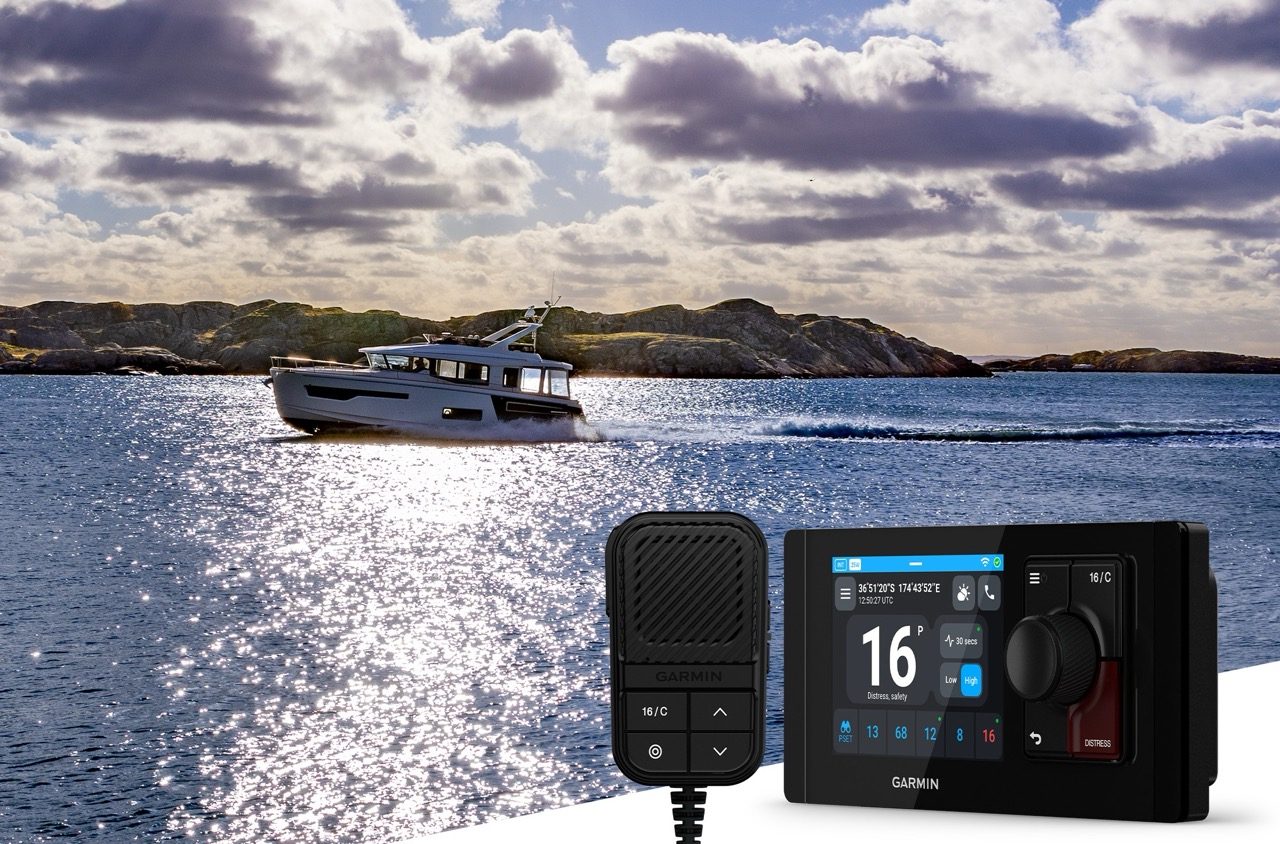
Garmin Signal VHF has won the 2026 DAME (Design Award at METSTRADE) awards in Amsterdam. Or rather, it shares the win.
On 17 November jury chair Andre Hoek named three joint Overall Winners – the Garmin Signal VHF & Remote system, the Scanstrut Wireless Powered Navigation Pole Light and the Teignbridge Propellers T-CPP controllable pitch propeller.
Teignbridge’s T-CPP is a controllable pitch propeller that changes pitch by moving trailing edge sections on fixed blades – the jury says it can be up to 20% more efficient than a fixed pitch prop.
According to the organisers that has never happened in the 35 years of the awards. The jury simply could not separate the three. It is Garmin’s first overall DAME win, while Scanstrut also won in 2017.
The awards run at METS (Marine Equipment Trade Show) in the RAI Amsterdam, 17-19 November. There were 153 entries this year, a record since 2008, and 74 nominated products – the most for two decades. All entry fees, a record €25,725, went to the Dutch sea rescue service KNRM.
Garmin Signal VHF and the RM 100 remote
Garmin launched the Signal range in May. There are two radios, the Signal VHF 400 and the Signal VHF 220, plus the Signal RM 100 remote station.
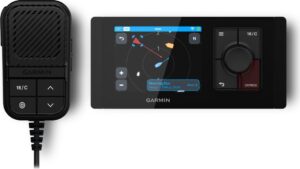
All three have a 3.5-inch colour touchscreen and a fist mic with its own loudspeaker. The VHF 400 adds a built-in Class B AIS (Automatic Identification System) transponder, and it runs VHF (Very High Frequency) and AIS off a single antenna.
The jury liked the extras, and so do I. The radio records the last three minutes of audio on up to three channels, so you can replay a call you only half heard. It can also watch six channels at once.
Distress calls go out with Class D DSC (Digital Selective Calling), and you can make a DSC call straight from the AIS plotter screen. Setup, MMSI (Maritime Mobile Service Identity) programming and software updates go through the ActiveCaptain app.
The RM 100 is a full second station, not just a handset on a long cable. It has the same screen, its own fist mic and an intercom between stations. According to Garmin’s install guide you can connect up to five remotes to one radio.
Garmin lists the Signal VHF 400 at $1,499.99 (US$1,500/€1,365/£1,137 excluding VAT/sales taxes), the VHF 220 at $999.99 (US$1,000/€910/£758 excluding VAT/sales taxes) and the RM 100 at $699.99 (US$700/€637/£531 excluding VAT/sales taxes).
Mind the network side
I like the remote idea a lot. But there is a catch in Garmin’s own installation instructions.
The Signal kit uses Garmin BlueNet and also works with the older Garmin Marine Network. On a mixed boat, though, with a BlueNet 30 gateway between old and new, a remote on the Garmin Marine Network side cannot talk to a radio on the BlueNet side. Garmin says all Signal VHF devices must sit on the same side of the network.
And a boat with only Garmin Marine Network kit needs an adapter cable (part number 010-12531-01) for the radio and for each remote.
So if you plan to add a flybridge station to an older Garmin install, sort out the cabling first.
I think it is an odd limit for a product that is all about using the radio from anywhere on board. Hopefully Garmin can fix it in software.
Why BlueNet and not OneNet?
BlueNet is quicker than the old Garmin network, at up to 1 Gbps, and the connectors are smaller and waterproof. It also talks to older Garmin Marine Network kit through a BlueNet 30 gateway, which is handy if you already have Garmin gear.
But I keep wondering why Garmin is still using its own Ethernet network – first the Garmin Marine Network, now BlueNet – when the NMEA (National Marine Electronics Association) has agreed OneNet as the open Ethernet standard.
OneNet is meant to do much the same job, only as an open standard, and it officially goes from 100 Mbps up to 10 Gbps. So far only a handful of products are certified. Garmin does not really explain why it has gone its own way.
Other DAME winners in marine electronics
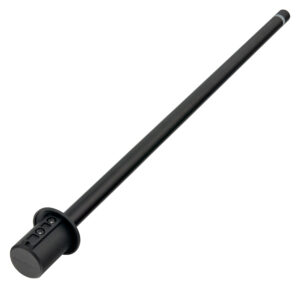
Scanstrut shares the Navigation & Communication category win with Garmin. Its pole light has a sealed magnetic power connection in the socket, so there are no metal pins to corrode. The light switches on when you push the pole in, and it comes in 600 mm and 1200 mm lengths.
Digital Yacht picked up two Special Mentions – one for the NAVDoctor Pro NMEA 2000 diagnostics tool and one for the SafeLi battery gas detector. Raymarine got a Special Mention for its RCU-1 autopilot remote, and ePropulsion for the Spirit 1 electric outboard.
The other category winners were the Facnor Tackfurl, the Mustang Women’s Tidal Waterproof Bib, the Blue-Airco Multizone Control Kit, the MOTA Cooling System H2 Marine One, the OHNOH2O WIF-Pro and the Sensiblue S4. The August Race Oceans Assured Compliance Platform, submitted by Lankhorst Taselaar, took the Environmental Design Award.
If you are at the show, all 74 nominated products are on display in the DAME Showcase in Hall 13. Garmin is on stand 01.103.